

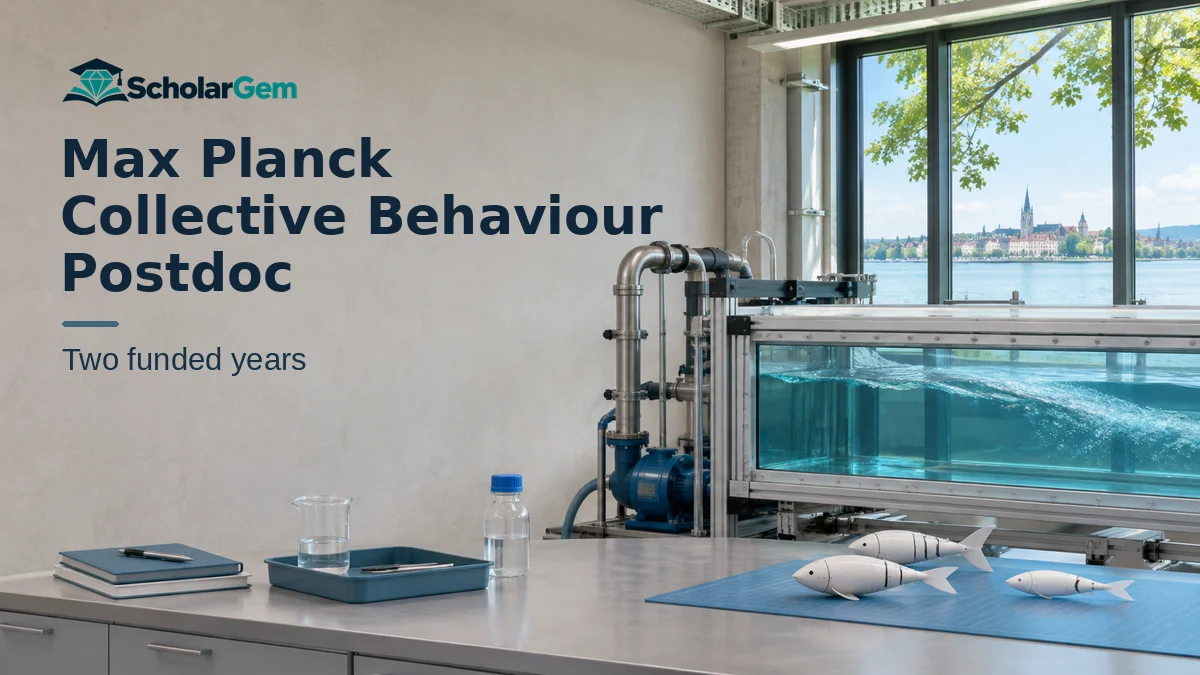
The Max Planck Collective Behaviour Postdoc is a full-time research position in Constance, Germany. The Max Planck Institute of Animal Behavior funds it for two years, with a possible extension. Applications are due by 6 December 2026.
The Li Lab studies how animals and robots interact and move together in water. The vacancy is suited to researchers trained in areas such as fluid mechanics, physics, robotics or applied mathematics. The institute asks for a single PDF containing the application material.
Max Planck Collective Behaviour Postdoc details
The institute’s Department of Collective Behaviour works with the University of Konstanz and its Centre for the Advanced Study of Collective Behaviour. The project investigates how interaction between individual swimmers can produce group motion. The post combines experimental and computational work.
The official vacancy gives 1 January 2027 as the planned start at Constance. Applicants can use the project description to decide how their prior work relates to the lab’s questions. The advertisement leaves room for the appointee to help shape the focus.
Employer | Max Planck Institute of Animal Behavior |
|---|---|
Location | Constance, Germany |
Role | Full-time postdoctoral researcher |
Duration | Two funded years, possible extension |
Pay | TVöD-Bund, based on experience and qualifications |
Deadline | 6 December 2026 |
Opportunity | Max Planck Collective Behaviour Postdoc |
Stay Updated with Scholar Gem
Follow Scholar Gem for verified scholarship, fellowship, and education updates.
Check the official source before submitting an application.
Max Planck Collective Behaviour Postdoc benefits
The institute offers two funded years and remuneration under the federal public-service collective agreement, based on experience and qualifications. It lists the usual social benefits. An extension is possible and depends on the institute’s arrangements.
The role offers access to flow tanks, robotics facilities and computing resources, as well as mentoring and support for conference travel. For related German research roles, compare the Max Planck MRI Postdoc and Max Planck Climate Risks PhD. The latter is a doctoral rather than a postdoctoral route.
Eligibility
The institute seeks a PhD or equivalent training in a relevant discipline. The vacancy asks for a strong quantitative background, programming and experience with large datasets. It also requires written and spoken English, while German is not required.
The lab values experience in experimental or computational fluid mechanics, active matter or related areas. Work on swimming, biologically inspired robots or other research crossing behaviour and engineering can also fit. Applicants should relate their publication record and skills to the vacancy’s research focus.
Required Documents
The official Max Planck vacancy requests one PDF submitted through its application management system. The motivation letter must describe your research interests, their connection to the project and one or two questions you would pursue.
Keep the motivation letter within two pages. Choose a writing sample that demonstrates the research or analysis skills relevant to the role.
- Required: motivation letter, up to two pages, with one or two research questions.
- Required: CV with publication list.
- Required: contact details for two or three referees.
- Required: one writing sample, such as a publication or manuscript.
- Conditional: PhD certificate if the degree has already been awarded.
How to Apply
Use the application management system linked from the institute’s vacancy. Confirm the posting title before uploading the PDF. The employer identifies the project as Fluid-Mediated Collective Behaviour in Animals and Robots.
Open the project description before drafting the letter and choose questions you can connect to prior work. The Volkswagen Agentic AI PhD covers a separate quantitative research route at doctoral level.
Application Deadline
The institute asks for applications by 6 December 2026. The advertisement does not state a closing hour. Use the link on the institute’s vacancy rather than sending application files to its research enquiry address.
The listed start is 1 January 2027 in Constance. If you have questions about the research or timing, the vacancy gives the lab’s contact details.
Frequently asked questions
How long does the Max Planck Collective Behaviour Postdoc last?
The full-time appointment is funded for two years. The institute says an extension may be possible. The official vacancy lists Constance as the work location and 1 January 2027 as the planned starting date.
What language is required for the position?
The institute asks for excellent written and spoken English. German is not required. Applicants should also show relevant quantitative and programming skills, along with a publication record appropriate to their stage as a researcher.
Is there a fixed salary figure for the postdoc?
The advertisement does not give a single salary amount. Pay follows the federal public-service collective agreement, with the amount based on experience and qualifications. The institute also lists access to the usual social benefits provided under that employment route.
How many referees does the institute ask for?
The application must include contact details for two or three referees. Put the details in the single application PDF with the motivation letter, CV and publication list. The vacancy does not ask applicants to upload reference letters.
How long should the motivation letter be?
The motivation letter must be no more than two pages. Describe your research interests, explain how they relate to the project and identify one or two questions you would like to address during the appointment.
Do I need to include my PhD certificate?
Include the PhD certificate if the degree has already been awarded. The vacancy lists the certificate as a conditional item alongside the application documents required from all applicants, including a writing sample and a CV with publications.
Conclusion
The Max Planck Collective Behaviour Postdoc is for researchers who can connect quantitative work with group behaviour in fluid environments. Check the project and facilities described by the employer before deciding which research interests to emphasise.
Submit one PDF with your letter, publication record, referees and writing sample by 6 December. Include the degree certificate if your PhD has been awarded.

