

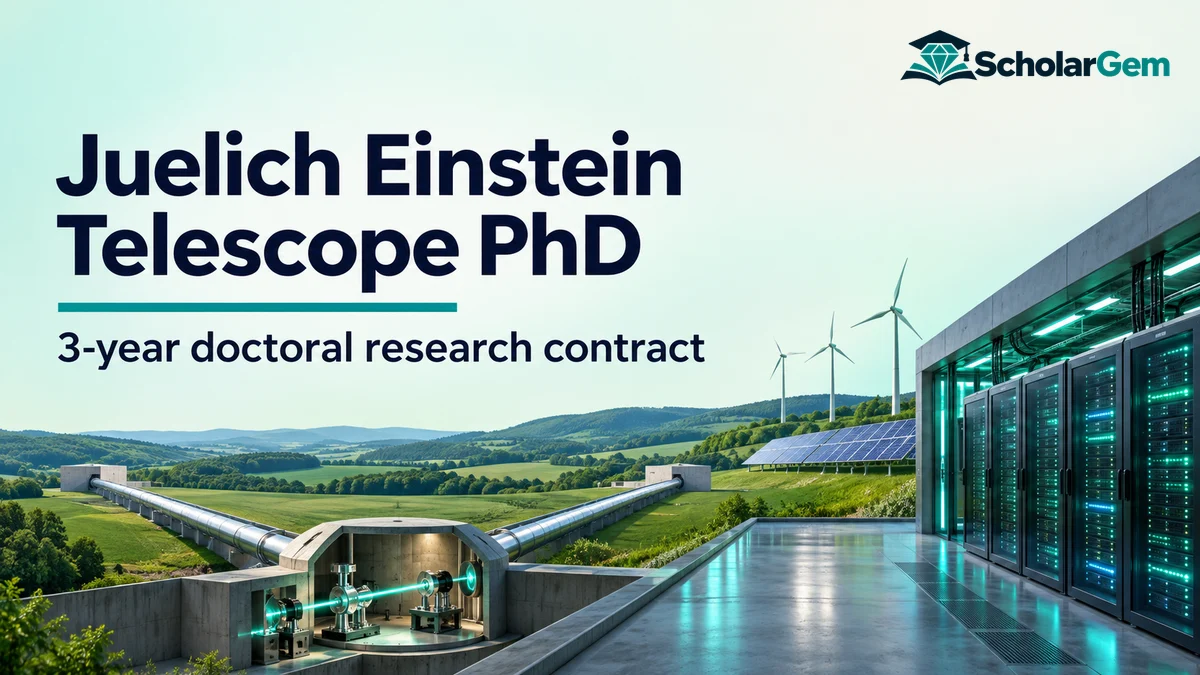
The Juelich Einstein Telescope PhD examines the environmental and economic implications of a data centre planned for the gravitational-wave observatory. The position is based at Forschungszentrum Jülich’s Institute of Climate and Energy Systems. The contract is initially limited to three years.
The project combines prospective life-cycle assessment with techno-economic analysis. It examines options such as batteries and hydrogen for integrating renewable energy. The employer asks for a related master’s degree and C1 German and English.
Juelich Einstein Telescope PhD details
The research takes place in Jülich Systems Analysis, ICE-2. The project considers how planned computing infrastructure could meet technical demands while limiting resource use. It covers energy storage and the interaction between the data centre and its power supply.
The doctoral researcher will help develop assessment methods, present results at conferences and publish findings. Expect to compare emerging technology options before their performance can be measured in a completed data centre.
Employer | Forschungszentrum Jülich |
|---|---|
Location | Jülich, Germany |
Reference | 588 |
Contract highlight | 3-year doctoral research contract |
Deadline | Open until filled |
Stay Updated with Scholar Gem
Follow Scholar Gem for verified scholarship, fellowship, and education updates.
Always recheck the official source before submitting an application.
Juelich Einstein Telescope PhD benefits
The employer lists TVöD-Bund E13 at 75%, depending on qualifications and duties. The package includes a year-end bonus under the collective agreement and 30 days of annual leave.
Jülich lists academic supervision and access to its JuDocS doctoral training and networking opportunities. Flexible working arrangements are subject to the work and on-site appointments. Compare related research routes through Jülich’s Root Dynamics PhD, KAUST’s research internship route and Imperial’s doctoral scholarship if your academic interests overlap.
Eligibility and documents
Applicants need a master’s in environmental, energy or industrial engineering or a related discipline, with good grades. The vacancy asks for basic Python and initial life-cycle assessment experience. Explain which parts of an assessment you have carried out.
The employer asks for at least C1 in both German and English. Certificates are preferred as evidence of the language level. The role also requires collaboration in an interdisciplinary team.
How to apply for the Juelich Einstein Telescope PhD
Open the employer’s vacancy page and locate the Apply link for this requisition. Verify the project title in the application system. The institute lists several research posts with different requirements.
Use your application to show your experience with life-cycle boundaries, energy systems or Python modelling. Read the portal’s upload instructions before submitting and retain the requisition number.
Application deadline
The employer says the listing remains posted until it successfully fills the position. There is no calendar cutoff. Check the vacancy’s availability when you are ready to submit.
The start date is the next possible date under the notice. Confirm your own start availability and any relocation details with the employer if invited to interview.
Frequently asked questions
Which institute hosts the research?
The vacancy is in Jülich Systems Analysis, part of the Institute of Climate and Energy Systems at Forschungszentrum Jülich. It sits in the Circular Economy department, whose work includes life-cycle sustainability assessment of emerging technologies.
What is the project’s main method?
The role combines prospective life-cycle assessment and techno-economic analysis. The researcher will assess a proposed computing centre for the Einstein Telescope and evaluate how energy storage and renewable generation could be integrated into the system.
Does the vacancy require German?
Yes. Jülich specifies at least C1 German and C1 English under the Common European Framework. It says a certificate is ideal to demonstrate the level. Applicants should review the full language guidance before relying on any particular evidence.
How is the salary calculated?
The employer lists TVöD-Bund pay group 13 at 75%, subject to qualifications and responsibilities. A collective agreement governs the scale and year-end bonus. The vacancy does not promise a single take-home figure for every candidate.
How long is the initial contract?
The initial appointment is limited to three years. The employer offers support from a doctoral supervisor and lists research training and networking through JuDocS. Check the official notice for employment conditions and any discussion of an extension.
Is there a fixed application cutoff?
No. The employer says it will keep the advertisement published until the position is successfully filled. Check the exact vacancy page before submitting. The start date in the notice is the next possible date.
Conclusion
The Juelich Einstein Telescope PhD is tied to a specific research project and contract. Read the responsibilities and select evidence that shows your contribution to comparable work.
Check the original requisition before sending the application. Save the confirmation so you can identify the role when following up.

