

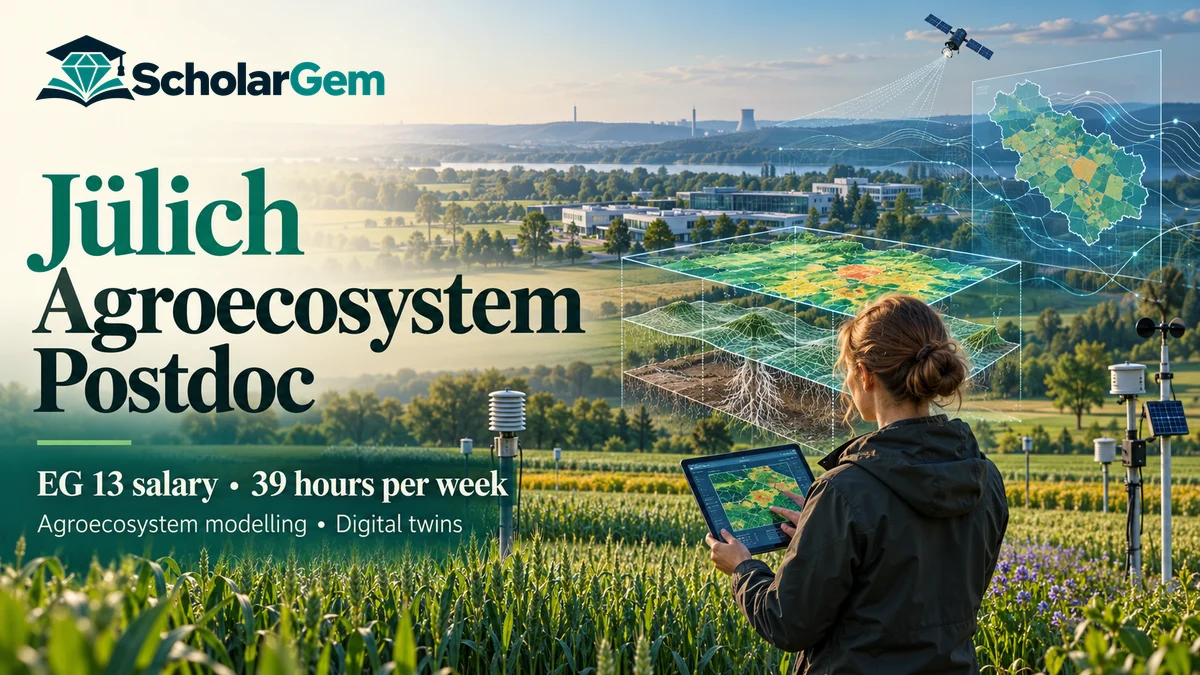
The Julich Agroecosystem Postdoc develops digital twins for agricultural systems at Forschungszentrum Jülich. The work combines process-based models, observations and data assimilation. It is a postdoctoral research employment position.
The official role has a planned start of 1 January 2027 and a contract limited until 31 December 2030. It lists 39 hours per week and EG 13 TVöD-Bund remuneration. Applications remain open until the role is filled.
Julich Agroecosystem Postdoc Details
The position is part of PhenoRob2 Core Project 6. Its aim is to combine sensing technologies and models to build field- and farm-scale agroecosystem digital twins.
Research addresses crop performance, ecosystem functions and management trade-offs. Applicants should connect their modelling background to the project’s scientific questions rather than rely only on general data-science experience.
Institution | Forschungszentrum Jülich, IBG-3 Agrosphere |
|---|---|
Location | Jülich, Germany |
Reference | 2026T-0799 |
Start | 1 January 2027 |
Contract end | 31 December 2030 |
Hours and pay | 39 hours/week; EG 13 TVöD-Bund |
Application state | Until successfully filled |
Stay Updated with Scholar Gem
Follow Scholar Gem for verified scholarship, fellowship, and education updates.
Always recheck the official source before submitting an application.
Research Responsibilities and Benefits
The researcher develops and applies AgroC to simulate water, carbon, nutrient and energy fluxes. Integration with the Parallel Data Assimilation Framework is a central part of the work.
Jülich offers collective-agreement remuneration, professional development and international-employee support. The role includes 30 days of annual leave, flexible arrangements subject to tasks, pension contributions and a collective-agreement year-end bonus.
Julich Agroecosystem Postdoc Eligibility
Applicants need a master’s followed by a PhD in a relevant field. Examples include environmental sciences, geosciences, agricultural sciences, computing, applied mathematics and physics.
The profile requires strong modelling or scientific-computing preparation and very good Python or Fortran skills. Written and spoken English at C1 is required; German is an advantage rather than a mandatory condition.
Application Evidence and Technical Fit
Use the official recruitment portal’s document checklist. The public vacancy describes the qualifications but does not list specific application documents.
Present clear evidence of model development, reproducible scientific software and publications where relevant. Parallel or high-performance computing experience is advantageous, so describe its actual use instead of listing tools without context.
How to Apply for the Julich Agroecosystem Postdoc
Open the official vacancy and follow Online Application. Match the reference 2026T-0799 and the agroecosystem digital-twin title.
For other postdoctoral research routes, review Jülich computational neurology, Dartmouth Neukom and MOPGA environmental research funding. They provide different research settings and subject scopes, so check the required project fit rather than assuming identical eligibility.
Application Deadline and Contract Timing
Forschungszentrum Jülich states that the vacancy remains published until successfully filled. This is a rolling recruitment state rather than a confirmed calendar deadline.
The planned start and contract end are employment dates. They must not be used as application closing dates, and availability should be rechecked before submission.
Frequently Asked Questions
This postdoc combines environmental models with software and data-assimilation skills. These answers clarify the doctoral stage, language threshold and contract structure.
Rolling recruitment can finish before the proposed start. Check the official vacancy page again before you submit.
What type of position is this?
It is a postdoctoral research employment position with collective-agreement remuneration.
What coding skills are requested?
Very good Python and/or Fortran skills are required. Linux/UNIX scientific computing and modern software-development practice are also part of the profile.
Is German mandatory?
No. The vacancy requests C1 English and describes German as a bonus.
What is the contract end?
The official vacancy states that the role is limited until 31 December 2030.
Does it have a fixed application deadline?
No. It stays advertised until successfully filled, so apply while the official vacancy remains open.
Conclusion
The Julich Agroecosystem Postdoc is a focused role for researchers who can connect environmental modelling with observation-driven digital twins. The project requires both scientific depth and reliable programming practice.
Use the rolling official vacancy and demonstrate the requested doctoral and technical fit. Confirm the employment terms with the recruiting team.