

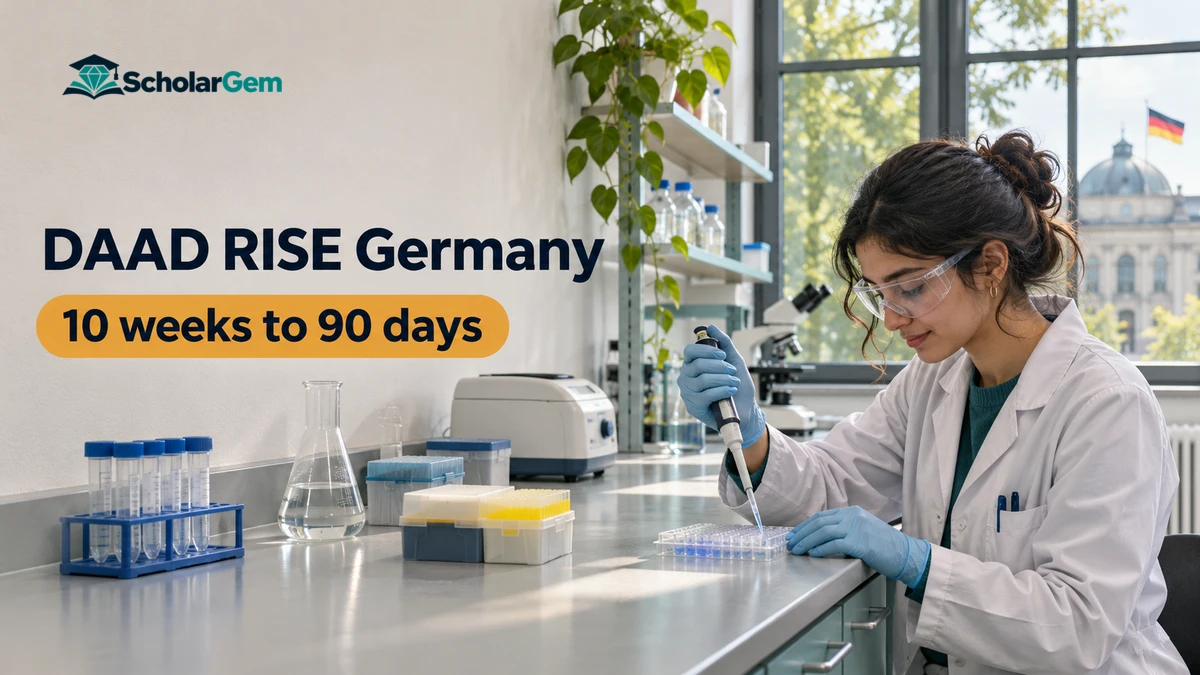
The DAAD RISE Germany places eligible science and engineering undergraduates in German research projects. Apply by 30 November 2026 at 11:59 p.m. CET for summer 2027. Your academic referee has until 15 December to upload their letter.
Start by checking where you study and whether you will remain an undergraduate after the placement. DAAD also requires a motivation letter for each project and evidence of your expected graduation date. Funding depends on the applicant route.
DAAD RISE Germany details
Placements normally last about three months, with a minimum of ten weeks and a maximum of 90 days. DAAD gives 15 May to 15 July 2027 as the window for starting. Agree the exact dates with the host.
You apply through the DAAD project database. The programme checks complete applications before passing them to internship providers. Hosts rank candidates in January, with announcements expected in February or March.
Operator | German Academic Exchange Service (DAAD) |
|---|---|
Location | Germany |
Duration | 10 weeks to 90 days |
Start window | 15 May to 15 July 2027 |
Applicant deadline | 30 November 2026, 11:59 p.m. CET |
Reference deadline | 15 December 2026, 11:59 p.m. CET |
Opportunity | DAAD RISE Germany |
Stay Updated with Scholar Gem
Follow Scholar Gem for verified scholarship, fellowship, and education updates.
Check the official source before submitting an application.
DAAD RISE Germany funding
DAAD lists €992 per full month for eligible US, UK and Irish students on its route. It also lists health, accident and liability cover, an international travel subsidy, and €160 for travel to the RISE meeting.
For qualifying Canadian applicants matched through the Mitacs route, the published support is C$7,000 for travel and living costs, plus DAAD insurance. If you are looking for a company-hosted project, compare the BMW CAD Machine Learning Internship and the BMW Industry AI Internship. Those have separate employer requirements.
Eligibility
DAAD requires current bachelor’s enrolment at a college or university in the United States, Canada, the United Kingdom or Ireland. Eligible fields include biology, chemistry, physics, earth sciences, engineering, computer science and closely related subjects.
You must have completed at least two years of the degree when the placement begins and retain undergraduate status afterward. International students need proof of more than 12 months of study in one of the four countries by the application deadline. German citizens must document at least six years of residence outside Germany in their CV.
Required Documents
Follow the DAAD document instructions before you submit. Request the enrolment certificate early because its expected graduation date helps establish that you remain eligible after the internship.
The academic referee sends the recommendation directly through the database. DAAD requires a referee with at least a PhD, an institution letterhead and a signature. The applicant and referee have separate deadlines.
- Required: one motivation letter per project and a CV.
- Required: a self-prepared list, up to one page, of courses to be completed before the internship starts.
- Required: an official digital transcript or a copy of a certified paper transcript.
- Required: an enrolment certificate with your expected graduation date. Use the DAAD-linked form or an accepted university certificate.
- Required: an academic recommendation uploaded by the referee.
How to Apply
Create a DAAD ID and open the internship database. Choose projects that match your studies and explain relevant preparation in each motivation letter.
Prepare the academic evidence in time for the earlier applicant cutoff. If you are already planning doctoral study, the Volkswagen Agentic AI PhD illustrates a separate employment route with different degree requirements.
Application Deadline
Submit your part by 30 November 2026 at 11:59 p.m. CET. The reference has its own cutoff at 11:59 p.m. CET on 15 December 2026.
The later reference date does not extend the applicant deadline. Save your application early enough to generate the link for your academic referee.
Frequently asked questions
Who can apply for the DAAD RISE Germany?
Bachelor’s students at a university or college in the US, Canada, UK or Ireland can apply if they study an eligible subject. They must have completed at least two years before the placement starts and remain an undergraduate after it ends.
When does DAAD close its application portal?
DAAD gives 30 November 2026 at 11:59 p.m. Central European Time for the applicant submission. The academic referee has a separate deadline of 15 December 2026 at 11:59 p.m. CET. Plan for both dates before starting.
Can international students at an eligible university apply?
Yes, provided they meet the programme requirements and can show more than 12 months of study at a college or university in one of the four eligible countries by the application deadline. The undergraduate status rules also apply.
How long does the DAAD RISE Germany last?
The placement normally lasts about three months. DAAD allows a minimum of ten weeks and a maximum of 90 days for this intake. The start falls between 15 May and 15 July 2027, with exact dates agreed with the host.
How much funding can a participant receive?
DAAD lists €992 per full month for eligible US, British and Irish students. Eligible Canadians matched through the separate Mitacs arrangement can receive C$7,000 for living and travel expenses. Insurance is provided under the published terms of both routes.
Does the applicant upload the reference letter?
The academic referee uploads the reference through the DAAD database using the link generated from the applicant’s saved form. The referee needs at least a PhD, and the letter must be signed and on official university letterhead.
Conclusion
The DAAD RISE Germany can suit undergraduates who can continue their degree after a summer placement. Check your university location, degree stage and graduation date before choosing projects.
Submit your documents by 30 November and give your referee the portal link. The academic reference has until 15 December.

