

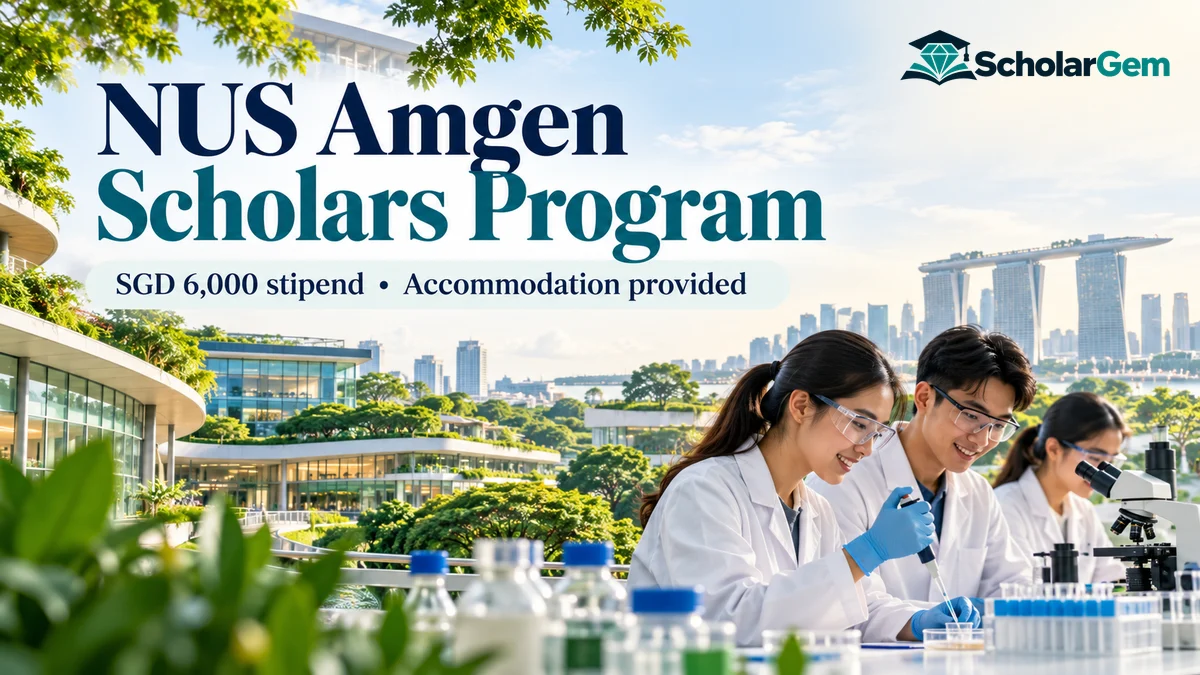
The NUS Amgen Scholars Program offers intensive biomedical and biotechnology research for undergraduates at Asian universities. The published package includes a SGD 6,000 programme stipend and arranged accommodation. International scholars can receive a travel grant of up to SGD 1,500 under the stated conditions.
New applications close on 1 February 2027 at 18:00 Singapore time. The research attachment runs from 31 May to 30 July, followed by the Japan symposium on 3 to 5 August. Applicants need to remain undergraduates for at least one semester or quarter after the programme.
NUS Amgen Scholars Program details
Research training is provided through NUS life-science laboratories and participating departments. Scholars work full time and complete safety training, presentations and a written report.
The regional symposium is part of the commitment. The current timeline places it in Kyoto, while a travel line elsewhere names Tokyo; selected scholars should confirm the actual itinerary with NUS before booking.
Host | National University of Singapore, Biological Sciences |
|---|---|
Research period | 31 May to 30 July 2027 |
Symposium | 3 to 5 August 2027, Japan |
Stipend | SGD 6,000 for the programme |
International travel grant | Up to SGD 1,500, subject to stated rules |
University location | Asia; no citizenship requirement |
Application cutoff | 1 February 2027, 18:00 SGT |
Stay Updated with Scholar Gem
Follow Scholar Gem for verified scholarship, fellowship, and education updates.
Always recheck the official source before submitting an application.
Benefits and funding conditions
The SGD 6,000 stipend covers living costs such as meals and local transportation. NUS arranges accommodation and describes a separate international travel grant capped at SGD 1,500.
International scholars buy approved travel first and retain receipts and boarding passes for reimbursement. Private health and travel insurance remain the student’s responsibility; NUS initiates the applicable Training Employment Pass process and covers its stated application fees.
NUS Amgen Scholars Program eligibility
Applicants must be continuing undergraduates at universities in Asia in biology, biotechnology, biomedical sciences, pharmaceutical sciences or relevant disciplines. They must complete the first year before the programme and resume study afterward.
A strong academic record, English proficiency and interest in pursuing a PhD are required. The FAQ states there is no citizenship requirement, so nationality and home-university location should not be confused.
Documents and independent referee reports
The 2027 checklist requests a status letter, transcript, one-page CV, one-page personal statement and English evidence. Use its prescribed filenames and collate the required files into one ZIP labelled with your full name.
Nominate at least two suitable faculty referees using professional email addresses. Referee reports are submitted independently; the applicant should not upload letters as though they were personal attachments.
Project allocation and comparable routes
Projects are offered to shortlisted applicants for preference ranking. First choice is not guaranteed, and the host asks students not to contact potential supervisors for projects.
For other laboratory routes, compare KAUST VSRP and the LPI Summer Internship. The EPFL computing summer internship concerns a different field and host-selection process.
How to apply for the NUS Amgen Scholars Program
Complete the form linked from the official NUS page with accurate university and referee details. The system then emails the document-upload instructions.
The FAQ allocates a short document-upload period after the form and gives referees their own instructions. Prepare everything first, because these stages do not extend the deadline for registering a new application.
Application deadline
The explicit 2027 timeline gives 1 February 2027 at 18:00 SGT (GMT+8) for new applications. Applications opened on 1 November 2026.
The page retains an older notification note, but its current 2027 timeline places admission notifications from mid-March onward. Confirm subsequent upload and referee deadlines in the actual emails rather than inventing one common cutoff for every stage.
Frequently asked questions
Is citizenship restricted for the NUS Amgen Scholars Program?
Citizenship of an Asian country is not required, according to the NUS FAQ. Applicants must instead be enrolled at an eligible university in Asia and satisfy the academic, field and continuing-undergraduate requirements. A qualifying nationality does not make a university outside the eligible region acceptable.
How much funding is listed for international scholars?
International scholars are offered a SGD 6,000 programme stipend, arranged accommodation and a travel grant of up to SGD 1,500 for the specified economical itinerary. They must arrange their own private health and travel insurance. Reimbursement conditions and the actual offer should guide travel budgeting.
What is the deadline for a new application?
New applications close on 1 February 2027 at 18:00 Singapore time. The document-upload email and referee messages may specify subsequent completion instructions, but they do not allow a late initial application. Preparing documents and referee details beforehand helps avoid an incomplete file.
Should the application documents be uploaded separately?
The 2027 checklist asks applicants to collate the prescribed PDF documents into one ZIP labelled with their full name. It explicitly warns against separate individual-document uploads. Follow the checklist’s filenames and the upload email, while referees submit their reports independently.
Must applicants approach a laboratory supervisor first?
Applicants should not contact potential NUS supervisors to obtain a project. Shortlisted scholars receive project choices and rank their preferences before allocation. Their first preference is not guaranteed, so the application should demonstrate relevant research interests without claiming a reserved laboratory placement.
Can an English-medium university letter replace a test score?
A university letter confirming English-medium undergraduate teaching can satisfy the host’s stated alternative. Applicants relying on test scores should check the current checklist’s thresholds and validity rule. Any transcript translation must also follow the university-issued English translation guidance rather than an unsupported informal substitute.
Conclusion
The NUS Amgen Scholars Program combines laboratory research with a regional symposium and a substantial but conditional support package. The single-ZIP checklist, independent referees and separate reimbursement process need careful preparation.
Use the current Singapore-time application cutoff and the emails issued for later document stages. Confirm the final itinerary and personal insurance before committing to travel costs.

