
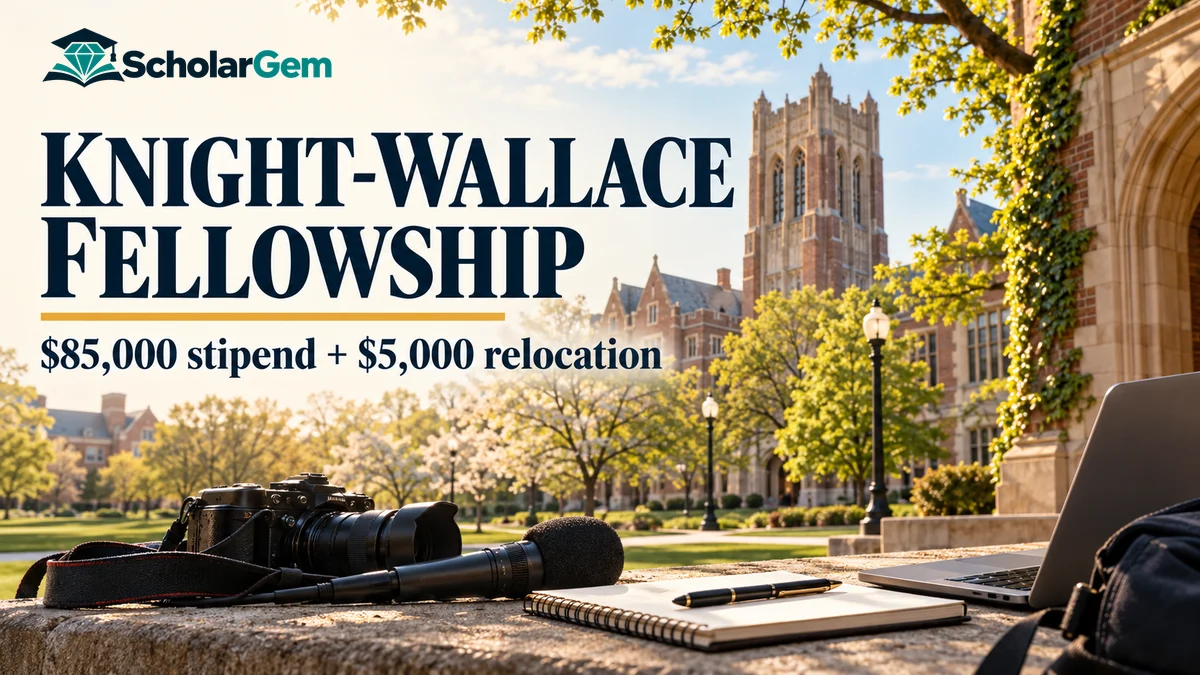
The Knight-Wallace Fellowship gives experienced journalists eight months at the University of Michigan. Fellows pursue an individual journalism project while joining seminars and workshops. Published support includes an $85,000 stipend and $5,000 for relocation.
Applications are open for 2027–2028. International candidates apply by 1 December 2026, while U.S. citizens have until 1 February 2027. Choose the correct route by citizenship rather than your employer’s location.
Knight-Wallace Fellowship Details
Wallace House selects up to 19 fellows for residential study in Ann Arbor. The programme gives journalists time to investigate a newsroom challenge, deepen subject expertise or develop a journalism venture.
It runs from late August through April and is intended to be the fellow’s primary professional focus. It is a professional-development opportunity rather than a route for applicants seeking a university degree.
Opportunity | Knight-Wallace Fellowship |
|---|---|
Host | Wallace House, University of Michigan |
Location | Ann Arbor, United States |
Duration | Eight months, late August–April |
Support | US$85,000 stipend plus US$5,000 relocation |
Deadlines | International: 1 December 2026; U.S.: 1 February 2027 |
Stay Updated with Scholar Gem
Follow Scholar Gem for verified scholarship, fellowship, and education updates.
Always recheck the official source before submitting an application.
Funding and Benefits
The $85,000 stipend is accompanied by $5,000 relocation support. Wallace House also pays specified health-insurance, course-auditing, workshop and required-activity costs; housing assistance helps fellows find accommodation rather than promising a free home.
Compare Stanford’s JSK Fellowship, FASPE’s journalism ethics route and GIJC conference funding. Each serves a different duration or purpose, so decide whether you need extended study, ethics training or conference access.
Knight-Wallace Fellowship Eligibility
Applicants need at least five years of experience and current journalism work for a news organisation or independently. Eligible roles extend beyond reporting to areas such as editing, data, audio, visual journalism, design and organisational change.
For applicants who are not full-time journalists, most work should still be journalism. Public-relations writers, lobbyists, public advocates, internal trade writers and degree-seeking applicants are excluded; accepted fellows must relocate and prioritise the programme.
Required Documents
Prepare a résumé, a project proposal of no more than 500 words, a project summary of at most 60 words, and a personal statement of up to 1,500 words. Explain the university resources and academic areas relevant to your own journalism goals.
The guidance requests three work samples, with additional medium-specific instructions. Non-English international samples need English translations, and Wallace House requires applicants to write their own submissions without AI assistance.
How to Apply
Use the official OpenWater form and select the citizenship-appropriate application. International applicants initially complete Phase One; references and possibly more samples are requested later from invited candidates.
U.S. applicants provide two professional reference contacts, including a current supervisor or an explanation if that is unavailable. Their reference deadline is February 7; confirm the current portal details rather than applying the international phase structure to a U.S. file.
Application Deadline
International applications close 1 December 2026, and U.S. applications close 1 February 2027. No closing hour is stated in the checked guidance, and submitting an international application in the U.S. portal is not accepted.
The main call plans arrival in Ann Arbor by mid-August before the academic year begins. Its current selection timeline gives international offers by mid-February and U.S. offers by early May; wait for individual communication before committing to relocation.
Frequently Asked Questions
Citizenship, work commitments and the project’s purpose matter as much as the stipend. A green card does not make a noncitizen a U.S. applicant under the published rule.
These answers clarify the separate application routes and residential expectations. Use the current instructions for your medium and citizenship when preparing the actual file.
Can a green-card holder use the U.S. route?
The programme sorts applicants by citizenship. A non-U.S. citizen normally uses the international route even when living or working in the United States; dual-citizenship questions should go to Wallace House.
Are international references required in Phase One?
No. The current international instructions collect reference information, with letters requested from candidates invited to Phase Two. Do not assume the U.S. reference process applies.
Can fellows take new assignments?
The FAQ says fellows must take leave and may not accept new work assignments during the programme. It also asks them to limit regular professional engagements.
Does housing assistance mean free accommodation?
No. The programme helps fellows locate and secure suitable housing. Distinguish that service from the stipend, relocation contribution and other listed paid costs.
Can an AI tool write the application essays?
No. Wallace House explicitly requires applicants to write their submissions themselves without AI support, including applicants whose second language is English. Follow that condition when preparing your own file.
Conclusion
The Knight-Wallace Fellowship offers time, university access and substantial support for journalism development. Its strongest fit is an experienced professional ready to step away from ordinary assignments for residential study.
Choose the correct citizenship route and prepare an authentic project rooted in your work. Keep the international and U.S. deadlines separate and plan relocation only after a confirmed offer.