
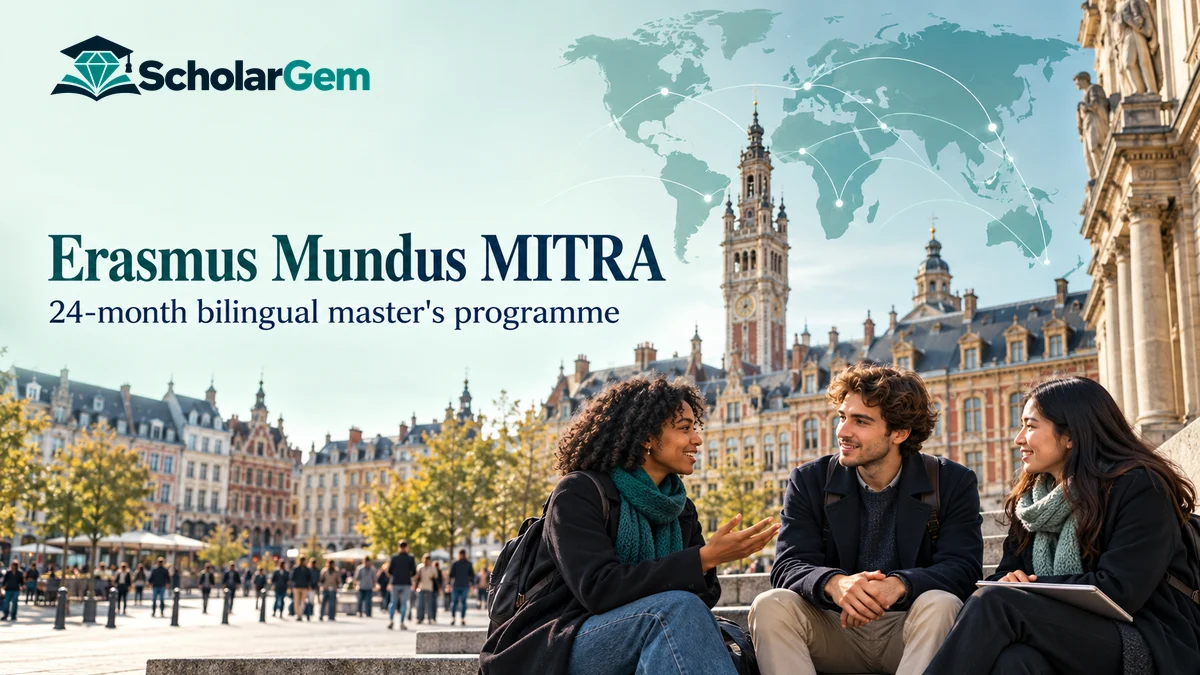
The Erasmus Mundus MITRA programme focuses on transnational migration and its effects on societies. Study lasts 24 months. Teaching requires both French and English.
The 2027–2029 admission campaign opens on 16 October 2026. Its confirmed closing date is 17 January 2027. Funding availability must be checked separately from programme admission.
Erasmus Mundus MITRA Details
MITRA combines academic study, mobility and field-oriented work. It prepares applicants for research and professional roles concerning migration.
The choice should depend on language readiness and subject fit. Compare the mobility requirements with your ability to study and work across different academic settings.
Programme | MITRA, Transnational Migrations |
|---|---|
Coordinator | University of Lille and consortium |
Duration | 24 months |
Languages | French and English, normally B2 |
Application window | 16 October 2026–17 January 2027 |
Funding | Erasmus Mundus scholarship: €1,400 per month for 24 months (limited places, depends on nationality) |
Stay Updated with Scholar Gem
Follow Scholar Gem for verified scholarship, fellowship, and education updates.
Always recheck the official source before submitting an application.
Benefits and Funding
The confirmed programme benefit is its consortium-based training and degree structure. The programme lists an Erasmus Mundus scholarship of €1,400 per month for 24 months, but it can only offer a limited number, so it is not guaranteed.
Applicants interested in another international social-science route can compare the Erasmus Mundus Journalism Scholarship. For broader postgraduate funding, review UNIL master’s funding and the East-West Center Graduate Degree Fellowship; none should be assumed to fund the same migration programme.
Erasmus Mundus MITRA Eligibility
The published entry profile asks for a bachelor’s degree in the social sciences or humanities, such as sociology, psychology, communication, political science, history or law. Check the programme’s rules if your degree is in a related field.
Both French and English matter throughout selection. A strong English score alone does not replace the French requirement.
Documents and Preparation
The admission page lists academic records, identity evidence, CV, motivation, project outline, language evidence, photo and an introductory video, with additional status documents. Check the platform for the exact version of each request.
Draft a project that relates to your training and interests. Prepare a short explanation of why a bilingual migration programme fits your next academic or professional step.
How to Apply
Create an account on the application platform linked from MITRA. Complete the file using its current document instructions.
Selection includes written assessment and interviews for shortlisted candidates. Practise discussing your project in both languages rather than preparing only a translated written statement.
Application Deadline
Applications close on 17 January 2027, midnight Paris time. The programme gives that wording without clarifying an end-of-day convention.
Submit before the final day rather than relying on a midnight interpretation. The detailed schedule places results in April, while generic wording elsewhere mentions March; await the programme’s individual notice.
Selection Criteria and Interview Preparation
Selection for Erasmus Mundus MITRA considers academic coherence, motivation, the proposed research or internship project, and proficiency in both teaching languages. The official guidance specifies language levels from B2 to C2 in French and English. A relevant degree and strong motivation do not remove the need to demonstrate both languages.
The published schedule places file assessment in January and February, interviews in February and the admission jury in March. The detailed calendar gives results in April, although a generic note elsewhere says late March. Prepare to explain your project orally and wait for the programme’s own notification rather than treating either general result description as an individual promise.
Frequently Asked Questions
Bilingual readiness and the quality of the proposed project are central to this application. An otherwise complete file may be unsuitable if it demonstrates only one teaching language.
Admission and funding must also be assessed separately. Check current financial terms instead of assuming that the Erasmus Mundus name alone guarantees an individual scholarship.
Is English proficiency alone sufficient?
MITRA assesses both French and English throughout selection. Applicants need preparation in both languages rather than an English score paired with no evidence of French ability.
Can a degree taught in English or French help prove proficiency?
The admission page says a bachelor’s completed entirely in one of those languages may serve as evidence for that language. Confirm the required proof and remember that the other language still needs to be demonstrated.
Does admission guarantee a monthly stipend?
No. The programme says it can only offer a limited number of Erasmus Mundus scholarships (€1,400 per month for 24 months, with eligibility depending on nationality). Check the current funding terms and assess remaining costs before accepting an offer.
Is an interview part of selection?
Preselected applicants are invited to an oral interview, with the current schedule placing interviews in February. Prepare to discuss your academic background, motivation and project in the programme’s languages.
When can I submit the online application?
The published campaign runs from 16 October 2026 to 17 January 2027. Use the official platform and submit early because incomplete files are not considered.
Conclusion
Erasmus Mundus MITRA suits applicants with a serious interest in migration and readiness for bilingual study. Language preparation and a coherent project should come first.
Complete the platform file early. Confirm current funding and mobility conditions before committing to an offer.